
GEO means optimizing your content for AI-driven search and LLM answers. How AI can improve this method comes down to three jobs: it finds optimization gaps automatically, it strengthens content for AI-driven search engines, and it ties your GEO work to measurable brand outcomes.
You do not need theory here. You need levers you can pull. AI cuts the manual audit load sharply. According to a Kontent.ai press release, AI-powered SEO and GEO workflows reduced the time needed to audit and optimize content performance by up to 80% compared to traditional manual methods. One global organization applied these workflows to more than 400,000 content items.
Five practical levers follow: automated gap detection and fixes, pattern and anomaly detection, predictive modeling and measurement, real-time optimization, and AI agent and tool integration. Each one makes your GEO program faster and easier to defend.
Key Takeaways
AI finds weak spots in your content and suggests fixes, saving you hours of manual work.
AI spots patterns in which content gets cited by AI engines, helping you focus on what works.
AI predicts which topics will earn citations and ties your GEO efforts to brand results like leads and revenue.
AI helps keep your pages fast and fresh so AI crawlers can read and cite them easily.
AI agents automate citation building and monitoring, but you still need human review to keep quality high.
How AI Can Improve GEO Data Automation
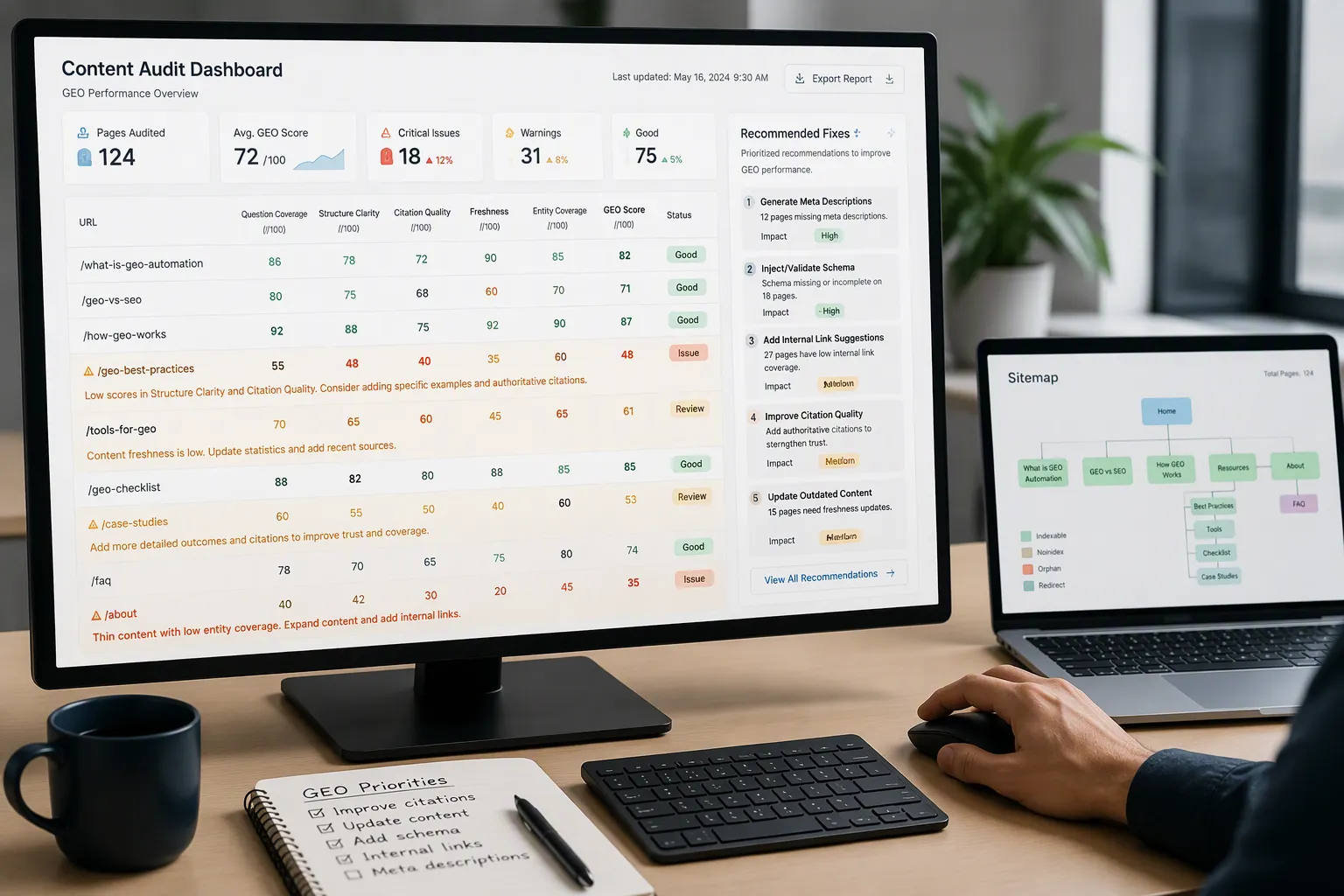
Manual GEO audits break down at scale. You cannot read thousands of pages by hand and still catch every weak definition or missing date. AI changes that math. It scans your whole content inventory, flags the gaps that block citation, and recommends fixes in a prioritized order.
Detecting Optimization Gaps Automatically
An AI audit starts with a full page inventory. The agent pulls every URL from your sitemap and stores baseline data per page: HTTP status, title and meta lengths, H1 count, word count, last-modified date, schema types, and canonical URL. It then scores each page on question coverage, structure clarity, citation quality, freshness, and entity coverage. Low scores come back with written explanations, so you know why a page failed.
The gap types it catches are specific. Watch for these signals:
Weak or missing entity signals, which let grounded models misrepresent your brand or default to a competitor
Dense, meandering prose without clear definitions, direct answers, or logical hierarchy
Client-side rendering delays that load core content late and hurt citation eligibility
Heavy interstitials that confuse content extraction
Unscoped claims that force the model to triangulate across chunks instead of reading a plain, dated statement
Thin author pages and weak entity markup that cost you tiebreaks in close comparisons
A good audit also separates branded from category queries. You may rank well when someone searches your name and vanish from category consideration sets. That split tells you where the real gap lives.
Applying Fixes Across Content Inventory
Detection is half the job. AI agents then recommend and apply fixes at scale. They generate meta descriptions and title tags, inject JSON-LD schema, suggest internal links, flag redirect chains, write alt text, and queue stale pages for refresh. Judgment-heavy work, such as thin content rewrites and canonical decisions, routes to a human queue. After each pass, the agent re-crawls affected URLs, confirms resolution, and escalates what remains.
Here is how the keyword fits the workflow: How AI can improve this stage is mostly about ranking. Each issue gets a severity score, then multiplies against a traffic-exposure multiplier from Search Console clicks. Critical errors rise to the top. Thin content waits its turn.
One caution matters here. Scaled AI content can trigger rank-and-tank patterns and inflate AI visibility metrics. The 2023 “SEO heist” case is the warning: a co-founder generated 1,800 articles with minimal human review, prioritizing volume over value. Pair automation with quality control. LLMs favor original research, real case studies, and verifiable author credentials. How AI can improve your results depends on that human layer staying in place.
Advanced Pattern Detection for AI Visibility
Spotting Citation and Ranking Patterns
AI engines do not reward the same signals as classic search. Only 12% of URLs cited by tools like ChatGPT and Gemini appear in Google’s top 10 organic results for the same query. Roughly 80% of LLM citations do not rank in the top 100 Google results at all. Your AI visibility therefore lives on a different map, and pattern detection draws that map for you.
AI tools scan citation data across engines and surface the signals that actually drive inclusion. Watch for these patterns:
Text-based authority beats backlink counts, with multi-platform brand mentions correlating at r = 0.87 with AI citations
“Fan-out” sub-queries account for 51% of all AI Overview citations, so engines split your prompt into hidden questions
Each platform has a sourcing personality: ChatGPT favors institutional sources, Perplexity leans on community-validated content, and Google AI Overviews prioritize video and multimedia
Earned sources dominate citations at about 64.6%, with brand sources second at about 34.1%
Engine identity explains more variation than persona or language. That finding means you tune strategy per engine, not per audience segment alone.
Flagging Visibility Anomalies Early
Anomalies precede revenue impact by weeks, which gives you a response window. AI monitoring catches the early signals: declining citation frequency on category queries, a competitor’s sudden visibility spike, vanishing brand mentions, or outdated pricing surfacing in answers. Set a baseline first. Run prompts for about two weeks before you draw conclusions, then track week over week for anomalies and month over month for decisions.
Thresholds keep alerts useful. A 30% drop in AI citation frequency within 7 days deserves immediate attention. Smaller movements inside your baseline noise band deserve nothing. Route alerts to your internal team first, verify the data, then act on the source pages that engines now cite.
Predictive Modeling and GEO Measurement
Forecasting Content Performance in LLMs
You can stop guessing which pages will earn citations. AI models learn from your historical citation data and predict which content types AI-driven search engines will quote next. Comparison pages, definition blocks, and dated research summaries tend to surface more often than opinion pieces. A forecast ranks your planned topics by citation likelihood before you write a word.
Treat the forecast as a planning tool, not a promise. Feed the model your own citation history, prompt set, and competitor data. Then test its predictions against real engine output each month. How AI can improve this stage is simple: it turns a slow, reactive content calendar into a ranked pipeline you can defend to leadership.
Linking GEO Investment to Brand Metrics
GEO visibility is a leading indicator. Brand awareness, leads, and revenue are lagging indicators. AI closes the gap by pairing the two and tracking movement over time. The table below shows the linkage.
GEO metric (leading) | Link to lagging brand metrics | Measurement approach |
|---|---|---|
AI brand appearance rate | Proxy for brand awareness | Brand mentions ÷ total eligible responses, across a fixed prompt set |
AI share of voice | Competitive awareness context | Brand mentions ÷ total mentions of all tracked brands × 100 |
AI-referred traffic | Bridge from awareness to behavior | GA4 referral groupings for AI platforms |
AI-referred leads and conversion rate | Customer acquisition | Conversions ÷ AI-referred sessions × 100 |
AI-referred revenue and pipeline | Financial outcome | Closed-won and pipeline by AI referral source |
AI search optimization ROI | Ultimate business case | (Attributable benefit − program cost) ÷ program cost × 100 |
Watch for a split signal. Visibility rises while qualified leads stay flat. That pattern points to weak prompt targeting, poor landing pages, or broken attribution. Diagnose those before you scale spend. Treat AI-referred sales as attributed, not automatically incremental.
Real-Time Optimization of GEO Strategies
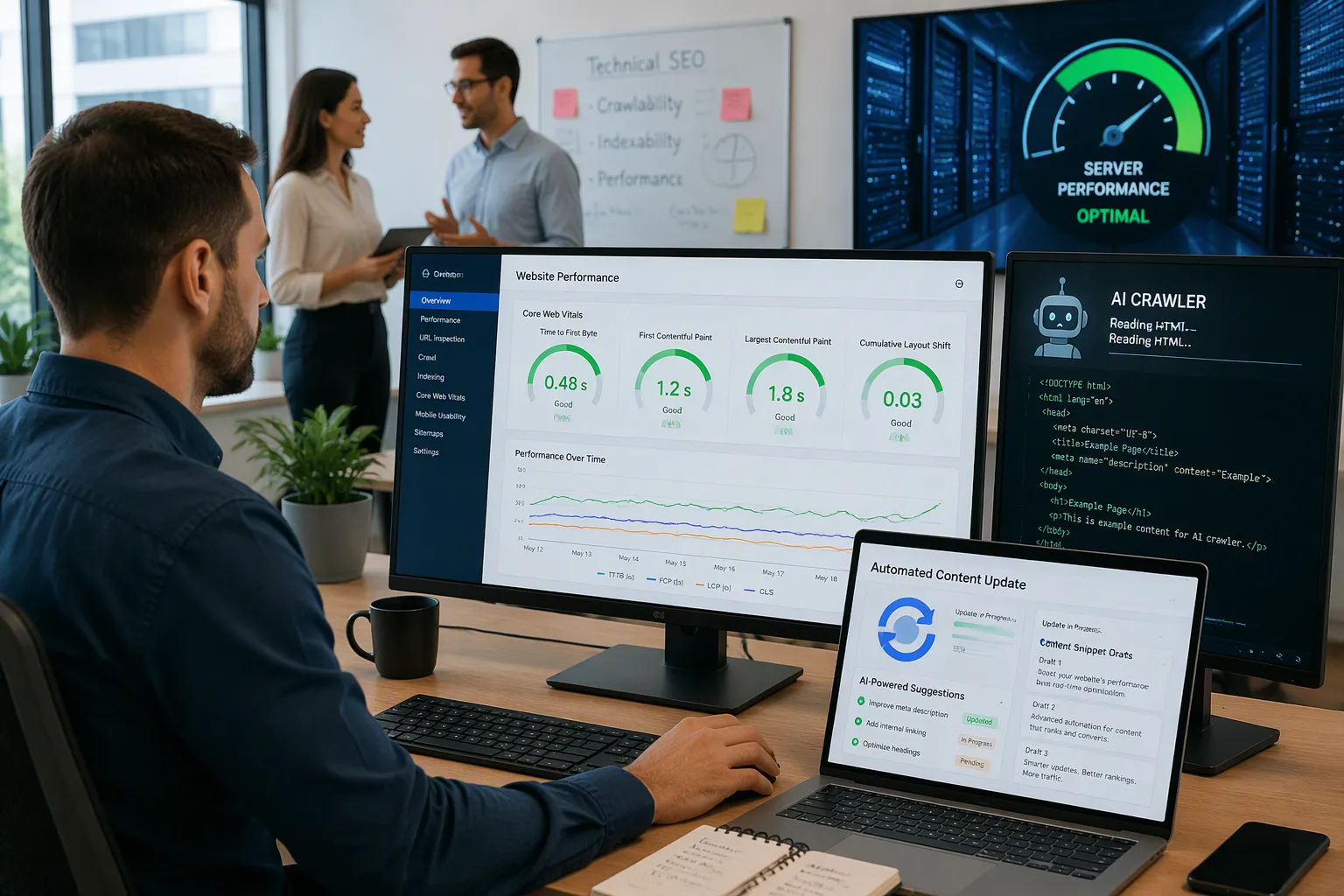
Improving Page Speed for AI Engines
Speed decides whether an AI crawler ever reads your page. GPTBot does not run a full browser or render JavaScript. It sees only the raw HTML response. A slow database query or an overloaded server makes the bot time out before it parses anything.
Time to First Byte matters more to AI crawlers than any other performance indicator because it determines whether the bot ever sees your content.
Track four metrics and hold them to these thresholds:
Metric | What it measures | Threshold for AI crawlers |
|---|---|---|
Time to First Byte (TTFB) | Time from request to first byte from the server | Below 200ms is great; above 600ms needs immediate investigation |
First Contentful Paint (FCP) | When the first content element appears | Under 1.8 seconds is good |
Largest Contentful Paint (LCP) | When the main content has likely loaded | Under 2.5 seconds signals trustworthy infrastructure |
Cumulative Layout Shift (CLS) | Visual stability during load | Under 0.1 keeps the DOM parsable |
Run each article through performance testing before publishing. Check the uncompressed HTML size and keep payloads small. Verify TTFB is under 200ms, then confirm Core Web Vitals are in the green. Only then push to production.
Speed is an enabling factor, not a ranking rule. A fast page with shallow content still earns few citations. How AI can improve visibility here is indirect: good server performance keeps discovery reliable, and accessible HTML keeps your key content visible to crawlers with limited rendering.
Dynamic Content Updates at Scale
Static pages go stale. AI engines reward fresh, machine-readable answers. Several platforms now handle updates at scale. Writesonic GEO scans competitors’ AI visibility, finds unanswered questions, and auto-drafts answer snippets. Surfer SEO builds topical maps and automated internal links between pillar and cluster pages. Yotpo Discover tracks visibility across ChatGPT, Gemini, and Google AI Overviews at the SKU level and deploys autonomous agents to close coverage gaps.
Fast indexing depends on how you serve the page. Use server-side rendering or static generation so crawlers receive fully rendered HTML. Pre-render dynamic pages, keep clean URLs and canonical tags, and add entity-rich JSON-LD to every page. Monitor with rendered crawls and AI visibility tests.
Real-time feedback loops keep this work honest. AI platforms ingest live performance data and regenerate content as algorithms shift. How AI can improve this cycle is the speed of the loop: declining pages get refreshed before visibility drops.
Integrating AI Agents and SEO Tools
AI agents turn GEO from a manual checklist into a running system. They crawl, monitor, and act on your behalf. How AI can improve this integration comes down to two jobs: winning citations and modernizing your playbook.
Securing Brand Citations in LLM Answers
Agents secure citations through a repeatable playbook. Start with these steps:
Make content citation-friendly with clear facts, short sections, and schema markup.
Optimize for AI crawlers by removing disallow rules in robots.txt and adding an LLMs.txt file.
Target high-value queries with dedicated, authoritative pages.
Earn authoritative backlinks from trusted sites.
Verify every key claim with a clear source.
Track monthly citation reports and double down on cited formats.
Monitoring matters as much as building. Track brand visibility score, focal mentions, top prompt categories, and top cited publishers. Mentions and citations are different signals: ChatGPT mentions brands about 3.2x more than it cites them. Citation outcomes are unstable — 40–60% of cited domains change monthly for identical queries. Set a baseline before you judge any movement. Continuous cross-platform monitoring catches that drift before a competitor takes your slot.
Shifting from SEO to GEO Best Practices
SEO and GEO share roots but diverge in practice. SEO targets rankings and clicks. GEO targets being the cited source inside an AI answer. GEO favors concise, Q&A-style content with explicit answers and structured data. SEO supports longer formats like case studies and white papers.
Schema tells the story. SEO schema qualifies a page for a display feature. GEO schema makes entities and claims unambiguous to a system that may never run your JavaScript. The success metric shifts too: reference rate — the share of generative responses that mention or cite your brand — replaces rankings as the core measure. Agents orchestrate this transition by running multi-step workflows. Early integration captures share; waiting optimizes for traffic that never arrives. Treat the two strategies as complementary, not a replacement.
AI upgrades the GEO method in five ways. It detects optimization gaps and applies fixes across your inventory. It spots citation patterns and flags visibility anomalies early. It forecasts which content LLMs will cite and links that work to brand metrics. It supports real-time speed and content updates. It also powers agents that secure citations and modernize your playbook.
The core answer holds: How AI can improve your program is by making GEO faster, more measurable, and better aligned with how AI-driven search engines surface and cite content.
Adopt these practices with care. Keyword stuffing, writing only for LLMs, and skipping structure and metadata all backfire. Keep human review in the loop, and treat editorial discipline as a prerequisite, not an option.
Scaled content without quality control inflates visibility metrics and erodes trust. Build for readers first, then verify AI visibility.
FAQ
What does GEO mean, and how does it differ from SEO?
GEO means optimizing content for AI-driven search and LLM answers. SEO targets rankings and clicks. GEO targets being the cited source inside a generated answer. You still need solid structure and metadata, but your success metric shifts to reference rate instead of position.
How long should you wait before judging a GEO result?
Set a baseline first. Run your prompt set for about two weeks before you draw conclusions. Then track week over week for anomalies and month over month for decisions. Citation outcomes are unstable, so a single snapshot tells you very little.
Which signals actually drive AI citations?
Text-based authority beats backlink counts. Earned sources dominate citations at about 64.6%, with brand sources second at about 34.1%. Multi-platform brand mentions correlate strongly with citations. Each engine also has its own sourcing personality, so tune your strategy per platform.
Can you automate GEO without hurting content quality?
Yes, if you keep human review in the loop. Let agents handle meta tags, schema, alt text, and stale-page flags. Route thin-content rewrites and canonical decisions to people. Scaled content without quality control triggers rank-and-tank patterns and inflates your visibility metrics.
What is the fastest technical fix for AI crawlers?
Improve your Time to First Byte. GPTBot does not render JavaScript, so it sees only the raw HTML response. A slow server makes the bot time out before it parses anything. Aim for a TTFB below 200ms, then confirm your Core Web Vitals are in the green.
发表回复